
scPEFT: Parameter Efficient Fine-Tuning single-cell Large Language Models
Published:
Motivation
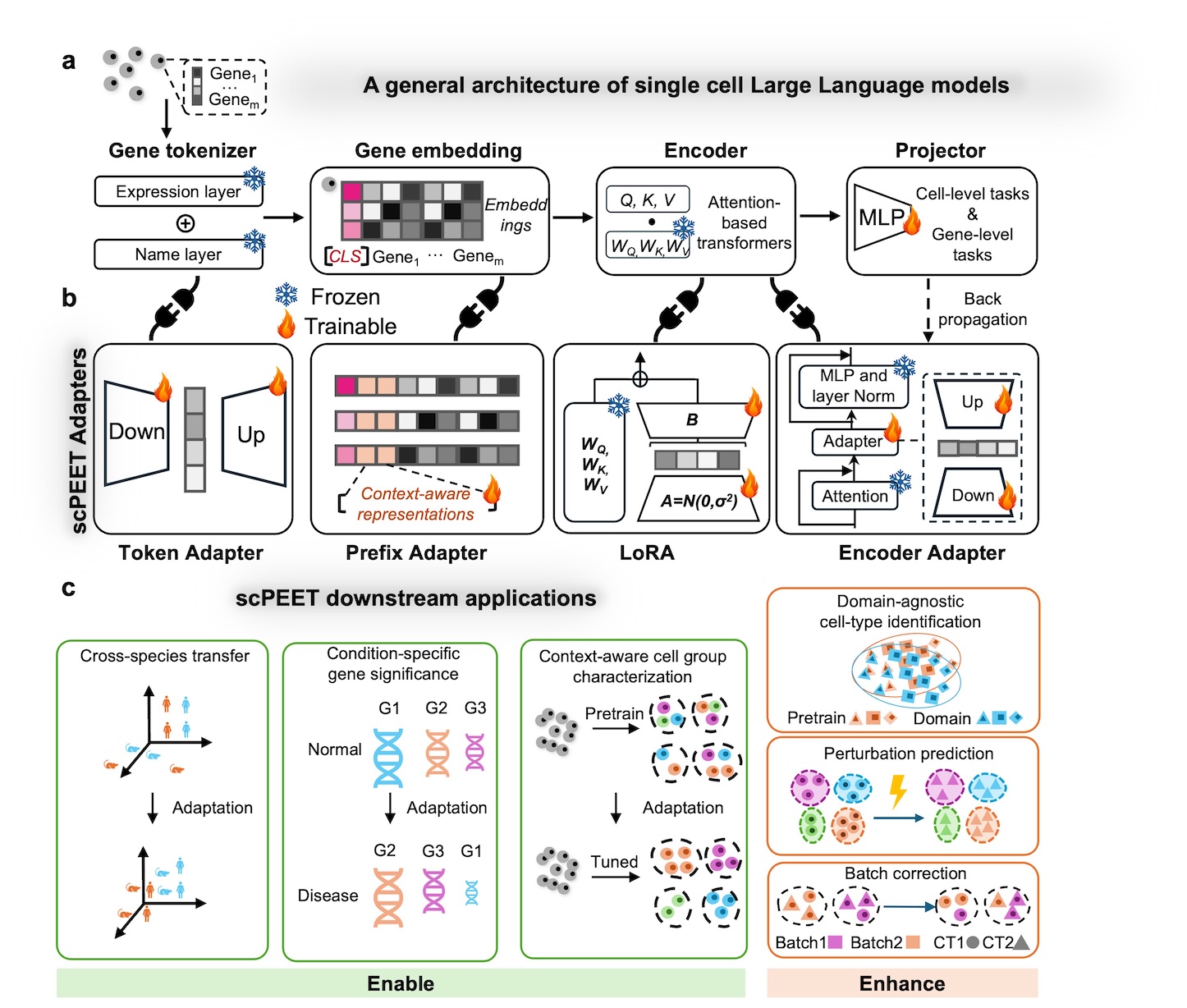
Recent advancements in single-cell Large Language Models (scLLMs) show promise in a variety of tasks within familiar cellular contexts and many scLLMs have been released. However, in out-of-context scenarios, such as unseen diseases, treatments, uncharacterized cell populations, or across species, scLLMs often perform unreliably, leading to misinterpretations. Current strategies to address this challenge primarily focus on scaling up pretraining data and model parameters, which demand significant computational resources and extensive data collection, restricting accessibility for most users of scLLMs with limited resources. Here, we introduce scPEFT (single-cell Parameter-Efficient Fine-Tuning), a novel framework that efficiently calibrates general scLLMs for out-of-context use cases by integrating low-dimensional, learnable, and pluggable adapters. scPEFT democratizes scLLMs, making them accessible to a broader research community, including those with limited resources. It enables context-specific single-cell analyses without requiring prohibitively expensive computational power while maintaining generalizable performance and interpretable insights. Additionally, by analyzing its attention mechanism, scPEFT facilitates disease-specific biomarker detection for particular cell types and states, enhancing the clinical applications of scLLMs. This novel utility paradigm can also be extended to other biological and biomedical foundation models.
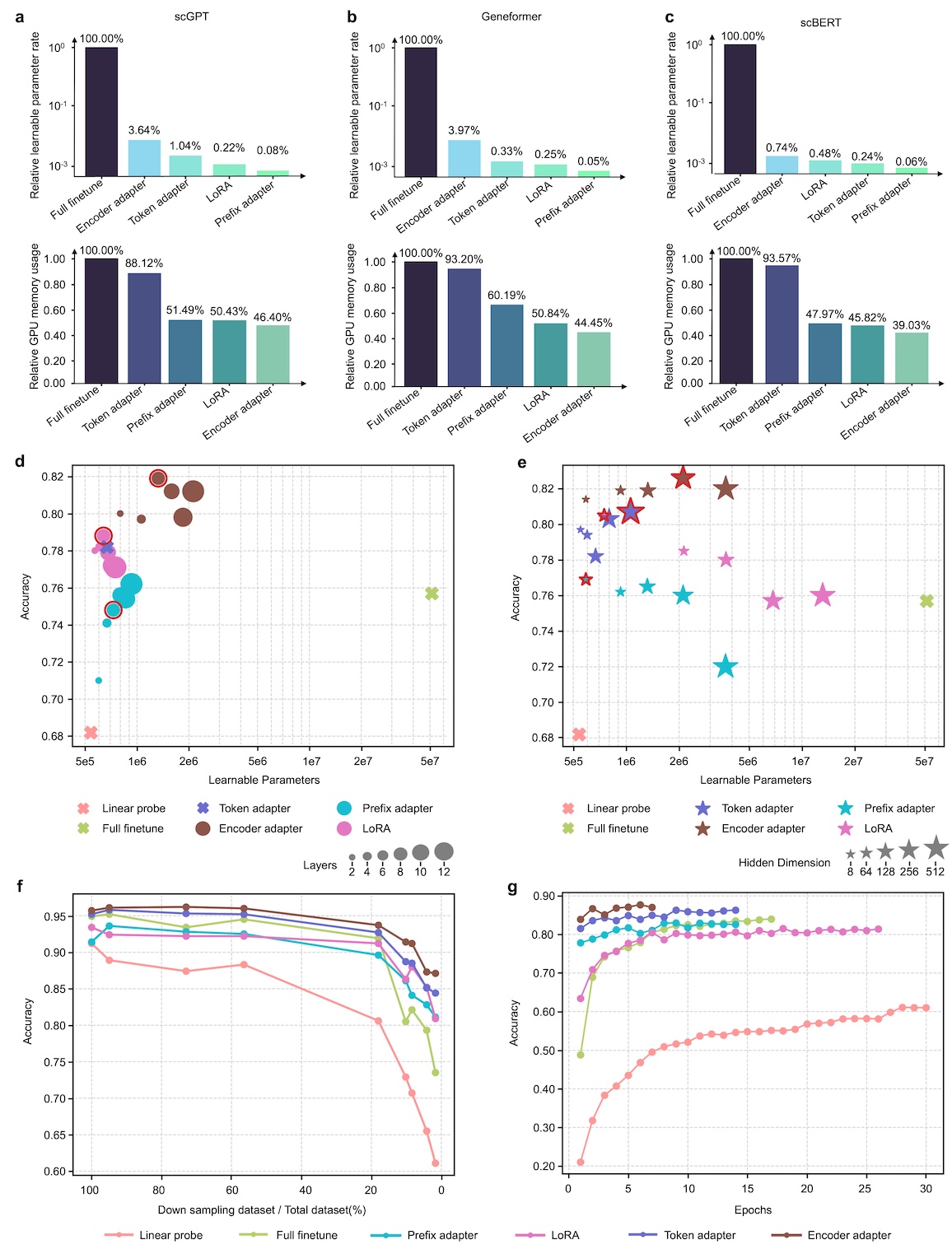
Computational demands reduction for adaptation of scLLMs
By constraining domain adaptation to a separate lower dimensional subspace, scPEFT reduces parameter tuning by at least 96% and lowers Graphics Processing Unit (GPU) memory costs by more than 50%, making scLLMs significantly accessible for research groups operating on limited resources.
Mitigating catastrophic forgetting
scPEFT re-parameterizes original scLLM model parameters with low-dimensional proxies, fundamentally differing from traditional fine-tuning. The plug-in adapters enable efficient customization of scLLMs without overwriting the original scLLM model parameters, reducing the risk of overfitting to noisy or biased task-specific data while mitigating catastrophic forgetting of pre-learned knowledge. This approach improves performance by 5-15% across diverse out-of-context scenarios, including disease-specific datasets, cross-species comparisons, and under-characterized cell groups 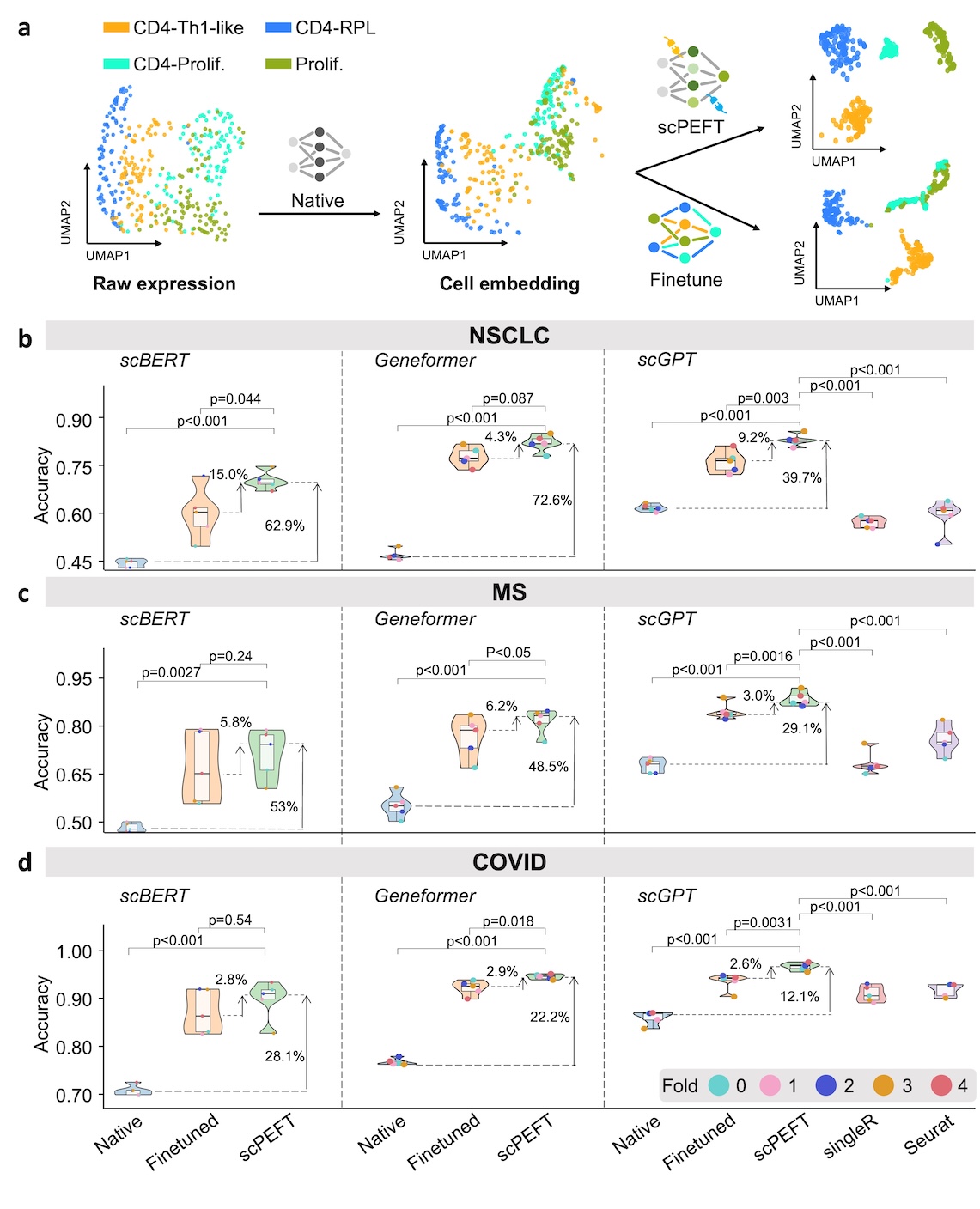
Biomarker insights
scPEFT provides unique insights for biomedical research by ensuring that the model’s attention scores align closely with pre-learned general gene activities and condition-specific requirements. This delivers COVID-infection-specific cell-state-associated genes and distinguishing phenotypical subpopulations from CD34+ enriched and bone marrow samples that other tools fail to discern. 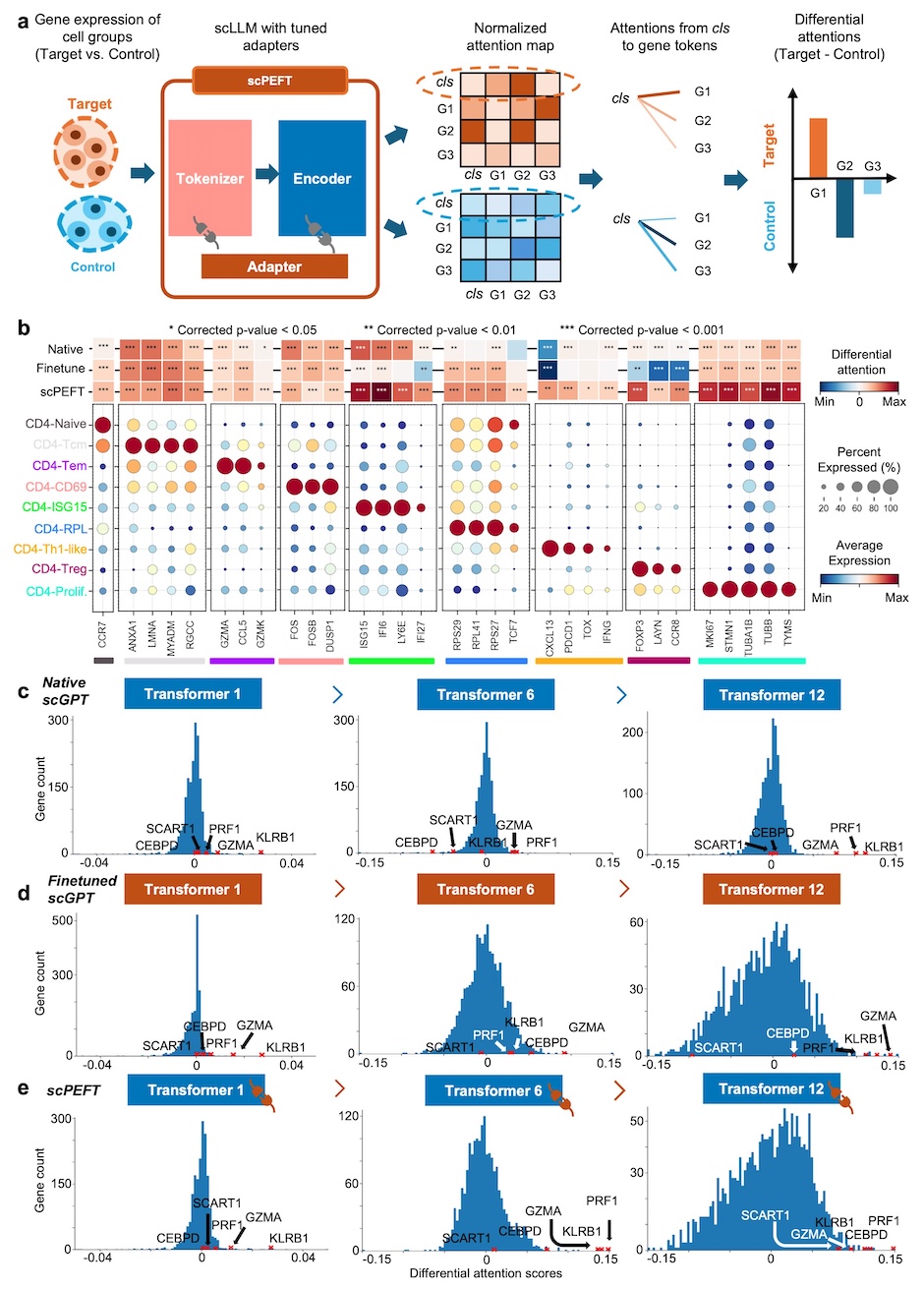
Cross-species Transfer
scPEFT enables the effective transfer of scLLMs, initially trained on human data, to other animal species beyond their pretrained corpus. This approach bridges the species divide by capturing a shared embedding subspace between pre-trained human data and various animal species, facilitating integrated analyses across diverse organisms. 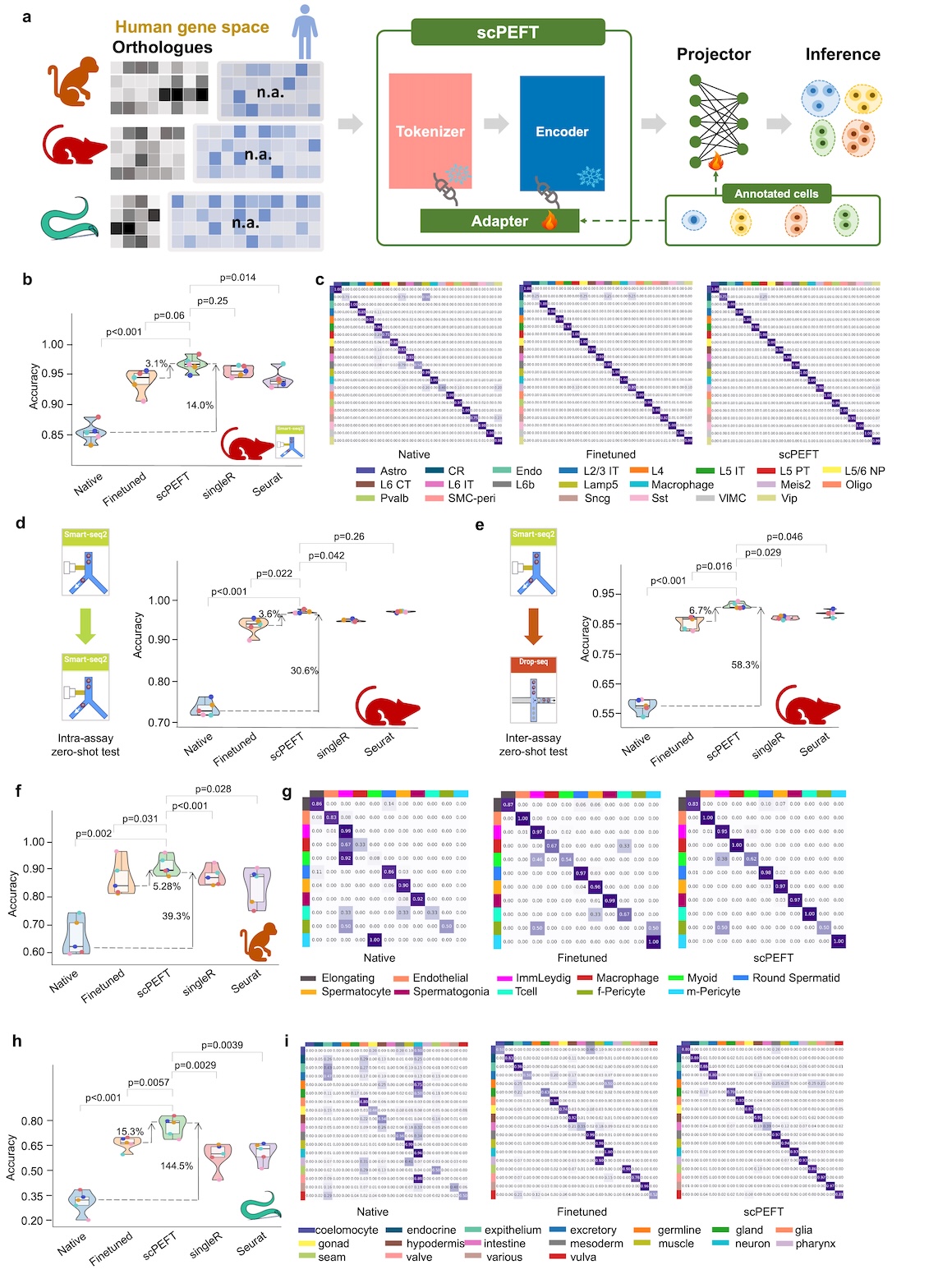
GitHub link
https://github.com/coffee19850519/scPEFT
Related Publications
Fei He, Ruixin Fei, Jordan E. Krull, Xinyu Zhang, Mingyue Gao, Li Su, Yibo Chen, Yang Yu, Jinpu Li, Baichuan Jin, Yuzhou Chang, Anjun Ma, Qin Ma, Dong Xu. Harnessing the Power of Single-Cell Large Language Models with Parameter Efficient Fine-Tuning using scPEFT. Nature Machine Intelligence link
Fei He, Ruixin Fei, Mingyue Gao, Li Su, Xinyu Zhang, Dong Xu. Parameter-Efficient Fine-Tuning Enhances Adaptation of Single Cell Large Language Model for Cell Type Identification. bioRxiv 2024.01.27.577455; Full text